Demo not supported in Internet Explorer. Use Edge, Chrome, Firefox or Opera.
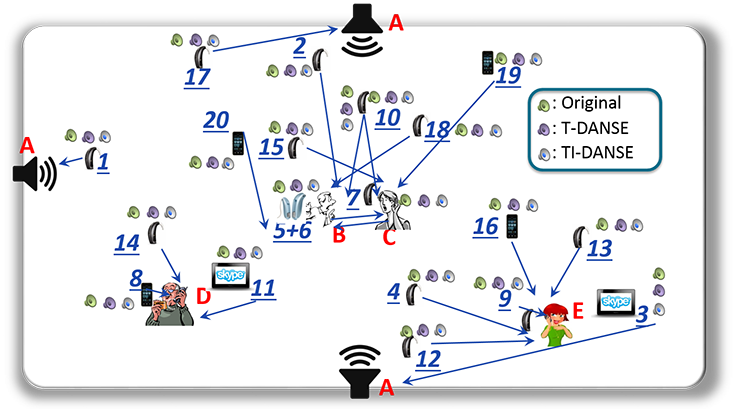
Click on the symbols to play the audio files.
This figure shows the output signals of a distributed speech enhancement algorithm pipeline, where multiple devices (blue numbers) collaborate to suppress background noise and to extract one of the five speech sources (red letters). Each device is interested in estimating a specific source, as it is observed at its local microphone(s). The interest of each device is denoted by the blue arrows (pointing to the source in which they are interested in).
The algorithm pipeline combines different methods and algorithms that were designed in the HANDiCAMS project. More information can be found in the following papers (*):
J. Szurley, A. Bertrand, and M. Moonen “Distributed adaptive node-specific signal estimation in heterogeneous and mixed-topology wireless sensor networks” Signal Processing, vol.117, pp.44-60, Dec. 2015. [Download]
M. H. Bahari, J. Plata-Chaves, K. Hamaidi, M. Muma, M. Moonen and A. M. Zoubir. Distributed multi-speaker voice activity detection in wireless sensor networks,” (in preparation), 2017
(*) Some of the sub-blocks in the algorithm pipeline are not yet published. Download links to these papers will be added once they are accepted/published.
In June 2016 IEEE Journal Selected Topics in Signal Processing accepts submissions for a special issue in heterogeneous and multi-task wireless sensor networks
From 19th to 21st September, 2014, the project manager of HANDiCAMS met with other EU projects in Lisbon, Germany, for the second Audio-Visual Gestalt workshop and EU ICT 2015 event 2015


 symbols to play the audio files.