

Events
Outreach events
- Published: Wednesday, 04 December 2013 11:44
HANDiCAMS aims to promote and establish a new ICT paradigm where multiple devices cooperate in multiple signal processing tasks, which is referred as to Multiple Devices for Multiple Tasks (MDMT). The initial theories and elementary proofs of concept devised in HANDiCAMS will reveal many new research directions and opportunities that can be incorporated in many different applications and technologies such as hearing instruments, wireless body area networks, ambient intelligence and ambient assisted living. Therefore, to enhance the high impact of the results obtained within the project, HANDiCAMS is committed to communicate the obtained research results as widely as possible. Here, we provide a list of the different outreach events undertaken by the network:
Audio-Visual Gestalt workshop
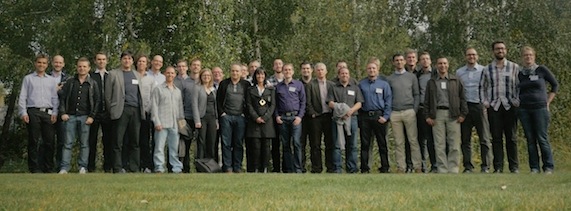
On September 29th and 30th, 2014 the HANDiCAMS researchers met in Bremen, Germany, for the first Audio-Visual Gestalt workshop.
The workshop constituted an excellent event to start a fluent communication and a long term collaboration with seven other EU-funded projects that research on the concept of combining multiple audio-visual sources and creating a richer experience for different users.
2nd Audio-Visual Gestalt workshop + EU ICT 2015
From 19th to 21st September, 2014, the project manager of HANDiCAMS met with other EU projects in Lisbon, Germany, for the second Audio-Visual Gestalt workshop and EU ICT 2015 event 2015
The 2nd Audio-Visual Gestalt workshop constituted an excellent opportunity to continue the discussion and collaborations with other EU-funded projects that revolve around the creation of added valued information from multiple sources of audio-visual data. Toward this goal, researchers and/or project managers of the different participating projects gave different presentations. In particular, for the HANDiCAMS, the project manager Dr. Jorge Plata-Chaves gave a presentation about the recent result obtained within HANDiCAMS consortium, i.e., the establishment of the MDMT paradigm.
In the EU ICT 2015 event (see http://www.ICT_EU_2015.eu), a number of parallel activities took place. One of these activities was aimed at presenting the Commission's policies and initiatives on Research & Innovation in ICT (Horizon 2020 Programme). There was also an interactive exhibition showcasing the best results and impact of the most recent EU ICT Research & Innovation and offering many networking opportunities that enhance quality partnerships, connect Research and Innovation and trigger collaboration. Moreover, one of these activies consisted in Horizon 2020 Work Programme 2016-2017 thematic sessions, which offered detailed information on the funding opportunities in ICT sector.
The project HANDiCAMS acknowledges the financial support of the Future and Emerging Technologies (FET) programme within the Seventh Framework Programme for Research of the European Commission, under FET-Open grant number: 323944.

© 2026 FET